



Collecting Garbage Without Plastic Trash Bags?
 It’s a new week, and I’m ready to talk trash. One of the most common questions I get about plastic-free living is what I do for garbage bags. And the second most common question is what to line our waste cans with if plastic grocery bags are banned.
Here’s my short answer: We don’t line our trash can with any plastic bags at all.
The longer answer is that since we make almost zero trash, and the trash we do make is dry, we don’t have any need for bags to collect it.
Composting Wet Garbage
Composting takes care of anything wet and icky. We collect all of our food scraps in a metal bucket that we keep near the sink. We used to line it with BioBags (more info on those below), but these days we opt for sheets of old newspaper that can be composted along with the food scraps. Originally, we didn’t bother with any liner at all, but eventually I found the aluminum bucket too hard to clean without it.

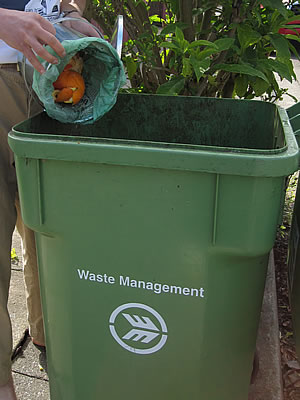
Here in the SF Bay Area, many of us have several options for composting. With very little effort, those of us in San Francisco, Oakland, Berkeley, and other areas with city-wide composting can simply empty our food scraps (including animal products) and food-soiled paper directly into our green bins, from which it will be picked up by the same company that hauls our garbage and processed at a commercial compost facility. In fact, according to a new San Francisco recycling law, putting food waste in a compost bin is not an option; it’s mandatory.
So what about those of us without city-wide composting?
 Many of us can still compost on our own. In fact, for several years, Michael and I used our own Compost Tumbler to make beautiful compost for our front yard. We chose a tumbler because we didn’t have the yard space for a traditional composter, and a tumbler could be set up right on our back deck.
There are plenty of other options for home composting besides the one we chose. Tumblers, traditional bins, worm bins, bokashi are all methods of converting bio waste into soil. Back in 2007, I explained why we chose our composting method. Here in Oakland, the city offers residents discounted composters and worm bins. Other cities may offer subsidized compost bins too. A quick search shows programs in New York City, Massachusetts, Thurston County WA, and many others.
Recycling paper, glass, & metal
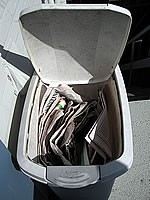 Composting takes care of the wet stuff. Most of what we have left is recyclable. We recycle clean paper, glass jars, metal cans. Michael recycles any plastic containers he ends up with. My plastic, as you know, ends up in my plastic collection for display on this blog. As it turns out, the major portion of our recycling is newspaper. We rarely eat canned foods because of the BPA lining inside metal cans. And we save glass jars for food storage.
Our recycling container, of course, is not lined with plastic. In fact, you should never put plastic bags into your recycle bin because they can jam up the sorting machines. I wrote extensively about recycling back in 2007 after researching the materials that could go into Oakland’s recycling system, and made visits to our local Davis Street Recycling Center and California Waste Solutions. Check out these posts for a deeper understanding of the recycling process.
The Rest of our Bagless Trash
The rest of our trash consists of dryer lint (of which there is very little because we hang most of our laundry to dry), floor sweepings, dental floss, Michael’s few unrecyclable plastic wrappers (he brings most of them to work to contribute to the Terracycle Wrapper Brigade), and bits of unrecognizable stuff here and there. We don’t compost our lint because some of our laundry contains synthetic fibers. Nevertheless, our small trash can fills up very, very slowly. We empty it about once a month.

Plastic-Free Pet Waste
We don’t need to use plastic bags for our cats’ waste either because we use SwheatScoop, [2016 update: Swheatscoop has switched to a plastic bag. We now use Integrity cat litter instead.] which is biodegradable, flushable litter. You might hear warnings about flushing cat waste because of a parasite many cats carry that is hazardous to marine animals. Our cats, however, have tested negative for toxoplasma gondii, and since they are indoor only cats, there is no chance they will pick it up. So for us, flushing is the best answer.
If we had dogs, we’d have to find another alternative. One possibility would be to pick up poop using compostable dog waste bags and dispose of it in a dog waste composter. However, using compostable dog waste bags is not recommended if the waste is simply going to the landfill. You’ll see why further down this post.
What If We Couldn’t Compost?
So, as I’ve said, the main reason we don’t need to use plastic trash bags is because there is nothing wet or icky in our trash. But what if for some reason composting were not an answer and we really did need to use some kind of liner? Here is a comparison of various options, starting with the least environmentally-friendly:
 Conventional plastic trash bags. They’re strong, waterproof, and come in various sizes. Some of them have convenient little tie strings. But the majority of their content is virgin plastic made from fossil fuels (oil or natural gas), which are non-renewable resources. Their production contributes to the worldwide problem of pre-production plastic pollution (aka “nurdles“). They will never biodegrade. Oh, and they cost money!
 Recycled plastic trash bags. They contain 55% – 80% recycled plastic, although only 10% – 24% is post-consumer waste. While they require less virgin plastic in their production than conventional bags, they still contain some new plastic which is destined to go straight from the box to the landfill, where it will never biodegrade. Oh, and they too cost money.
 Certified compostable trash bags made from bio-based plastics. Bags like BioBag are made from a combination of plant starches and fossil-based plastics that are certified to biodegrade in a well-run industrial compost facility. However, since they are synthetic, they are prohibited from certified organic compost, so not all facilities will accept them. And in the anaerobic conditions of a landfill, they will give off methane gas like any other bio-based materials. Methane is actually a more potent greenhouse gas than carbon dioxide. Plus, BioBags cost money!
Other Biodegradable Bags. Some of these are tricky. There are oxodegradable bags which are made from virgin plastic and contain a heavy metal to help them break down. And there are also bags which are a mixture of virgin plastic and various starches. The jury is out as to whether these bags actually decompose all the way or whether they simply break down into tiny pieces of plastic that last in the environment. One of the issues with these types of bags is that for proprietary reasons, manufacturers will not reveal the ingredients that are in them. If we don’t know what a plastic is made from, how do we know it’s safe?
Paper bags. From a practical standpoint, paper won’t solve the problem of wet garbage. Ecologically speaking, they have their own environmental impacts. Paper bags require materials (trees) and energy to produce. And once again, they will not compost properly in landfill conditions.
 Re-used plastic bags such as grocery, bread, and chips bags. Since these bags’ original purpose was to hold something other than garbage, as trashbags they can be considered to contain 100% post-consumer content. And in most places, they’re free. Here’s a funny video listing all the different kinds of packaging you can use for trash if plastic shopping bags are banned. It’s tongue in cheek, so please take it with the humor that’s intended:
Still, reused plastic packaging and bags are made from a non-renewable resource and bring with them all the problems of the first two types of plastic bags. And since the whole point of this blog is reducing plastic consumption, I’m not recommending bringing home new plastic grocery bags or packaging simply to line trash cans.
While we ourselves might not have a supply on hand from our own groceries, Freecycle and Craigslist could be good sources. Rather than accepting new plastic grocery bags to send to the landfill with our trash, why not use someone else’s — someone else who has not yet kicked their plastic habit. It’s not a perfect solution, but better than buying or acquiring new plastic to throw away. And a further suggestion would be to use the plastic bags only for wet garbage. Put the dry stuff in a separate can without any liner. That way, you’ll at least reduce the amount of plastic you need to use.
The fact is, there is no magically perfect way to dispose of garbage since the whole concept of garbage itself is not eco-friendly. The best option is to try and reduce the amount of waste we generate in the first place.
Note: This post was updated on 12/02/2012.
Very cute video. But a correction: it’s “hippie,” not “hippy…”. And yeah, I was one. And, contrary to Millenials who seem to blame my entire generation for their their woes, I’ve been vegetarian since 1972, and have composted since then, too. No methane from cows or animal manure supported by me, because I’m vegetarian.. I’ve never bought plastic trash bags, and I buy food and household items in bulk, as well. I don’t use harmful chemicals to houseclean. I make my own breads. And I’ve been a wildlife rehabilitator for 35 years, So I do my part both in green behavior, and by teaching others how to be green and compassionate, too. When folks leave my home, they become green ambassadors… if they aren’t already,
And I don’t shop at Whole Foods. I prefer to pay elsewhere for inexpensive nutritional value, not halogen lights and snooty employees. They’re also not happy (and I don’t blame them) if you get on line first to weigh your empty jars and containers, and then get on line a second time to make the poor cashier take the time to do a tare weight on food. No matter where I shop, though, many foods come in packaging. And WF has been caught shorting shoppers by not putting in the entire weight they claim in prepackaged foods (and grossly overcharging on animal proteins, but I don’t eat that stuff). And certainly, I prefer my loose produce to be protected (in a bag) from touching the conveyor belt at checkout, because it’s been found to grow out coliform bacteria, pseudomonas, E. coli, staph, etc. I’m not some Hipster who can afford a 25 dollar silicone reusable bag theth doesn’t fit celery or a head of romaine.
Plastics didn’t start with Boomers. It started with the PARENTS of Boomers… the WW II generation. They also trusted pesticides and herbicides. Read “Silent Spring” by Carson. Another small correction: the sack potatoes and apples come in, has holes or are mesh, unsuitable to wet garbage. The rigid containers that leafy green, etc. come in, also has leaky holes. And you won’t find empty bags for chips and cold cereals, etc. in my house, I don’t eat non-nutritive crap like that. So you still have a ways to go, regarding your Millenial eating habits and the bags and boxes you generate. And for those of us who live on a fixed income, frugality and being green isn’t even a matter of choice. The expense of superfluous plastic garbage bags is a nonstarter. So even though the video was funny, nothing you said was new: we and our mothers were already doing all that stuff.
In L.A., everyone burned their trash in Smoky Joes in their back yards, as a matter of good citizenship, until the day city visibility went down to zero. That’s when municipal garbage collection started, and plastic bag manufacturers saw their opportunity to make a killing. Plastic wrap was invented for the military in my parents’ generation, but it was greenish and stank. They had to figure out how to make it clear and odorless, then sold it to consumers. I’d recycled since my city started recycling but couldn’t before then. I get my clean newspapers for my kitchen and bathroom cans from the yellow recycling bins placed throughout the city: I got permission from that department, they said as long as I don’t take aluminum because that’s their real moneymaker. It can take me more than five years to use up enough aluminum foil to fill even one produce bag, I hardly ever use aluminum.
And I’ve never been to a Starbucks, unlike Millenials, so there’s no waste there, either. And I don’t eat fast food or “convenience foods,” as they were called. So no cans or boxes from that, either. You have a ways to go.
Your video presented the quandaries in a very cute way. But, this hippie has been green since before you were a twinkle in your momma’s eye.
All of your points are well taken. Just to be clear: that video was not created by me, and like you, I also don’t have any of the plastic packaging mentioned in the video. But we have to recognize that not everyone is willing to reduce their plastic to the level that you and I have and that we have to help people take the steps they are ready to take.
I wonder if all locations require bags at the curb or municipal sites? Could you just put a metal or plastic can at the curb unlined?
I’ve been trying to figure out how we used to manage before plastic. I remembered that in the 70s and 80s, our apartment building in NYC had metal garbage cans that were put out on garbage day. After they were emptied, they were rinsed out. The cans were kept in the Garbage Room. People put their garbage in them in paper bags, wrapped in newspaper, or dumped directly from the apartment trash can.
I don’t consider myself to be that old … but I do remember when we didn’t use anything to line the waste basket. We didn’t compost either but we just didn’t seem to generate much trash either. Life existed just fine before the plastic bag
We can’t compost oily food and most animal products and due a rodent problem in our neighbourhood, grains products are discouraged – we collect these in a container in the freezer and then wrap them in newspaper and throw them in the garbage bin on garbage day. Our community doesn’t currently have any community composting options.
I’ve always heard that you can’t compost dairy, meat, or bones. What do you do about this?
It’s not necessary to completely avoid using plastic. Use it responsibly, don’t “waste” it.
One sturdy plastic storage containers can last for years, and is more easily, and likely to be recycled than the thousands of flimsy bags it replaces. The properties that make plastic hard to degrade in a landfill give it integrity.
Use temporary containers made of plastic that can be later recycled if and when they lose their integrity. Many people have kitchen garbage containers which are too large and aren’t emptied frequently enough. A diaper pail is an ideal temporary kitchen container. Empty it at least once a day into an outdoor container.
All food except milk is shipped to stores in corrugated cardboard boxes which they have to pay to have taken away. If you have a curbside container garbage collection program, line just the bottom of that container with cardboard, and forego using other liners. The bottom liner will absorb the organic fluids from the waste, fall out into the collection truck and will degrade faster no matter how it is processed.
To clean temporary waste storage containers use soap, and water with a spray bottle, not detergent. You do not need to fill or scrub out the container. Grey water can be used. Let it air dry. ( A mall piece of scented soap bar left in the container will mask all but the strongest odors, like from onions. ) Soap is made from food byproducts, is easily biodegraded, and is a good for lawns.
Hi! This was really informative. However, I have a question. I read that you cannot compost meat, cooked food and oily stuff… Most of these are wet… How would you go about disposing of these without plastic bags? Thanks!
It depends on what type of compost facility you have access to. In areas with commercial composting, meat and oily foods can be composted because they are composted at very high temperatures in a very intense environment. In backyards, it’s more difficult to compost meat, dairy, and oily foods, but it cam be done. Here are some tips I found via a quick Google search: https://www.todayshomeowner.com/how-to-compost-cooked-foods-meats-and-dairy/
Great information, thanks for posting all of this. Trying to get my work site set up to recycle and was hoping to find a plastic bag alternative, looks like the Zero use of them is best. No wet garbage to speak of here so we should be able to just use the small recycle cans.
Use sturdy plastic containers instead of flimsy bags. All but food grade storage containers contain a percentage of recycled material of the same type. The problem with plastic isn’t that it is plastic, but that it is intentionally wasted.
I live in a very rural area that doesn’t have trash pick up. We have to load up our trash in the truck to take it off. That makes bags almost a necessity for transport purposes alone.
Reduce plastic but understand that most things are made of plastic and it’s reduced poverty and added to sanitation and water quality and safety. Use plastic carefully and recycle your plastic items. Bring your own mug to coffee shops, bring your own fork and spoon, don’t waste plastic bags, use a thinner compostable bag where available, use reusable shopping bags. but don’t be dramatic. Plastic is tech, water, communications, furniture, toys is washable, reusable, and recyclable and leave plastic processing and recycling to the experts. Anti plastic is anti sanitation, anti water accessibility, anti transportation, anti communications and is very dangerous, don’t go there.
I have been wrapping dry garbage with newspaper and rubber bands to keep it together. I live in an apartment that re cycles papers and metal containers. I simply cannot use indestructible plastic bags any more.Use a diaper pail and avoid making presents of your garbage. Use normal pails to hold your recycleables until it can be put into the pickup container.
I love your article. I am trying to figure out the best, most environmentally friendly way to get rid of trash.
We recycle (in a small town its limited the numbers….) we compost and use on our garden. We eat pretty clean so we dont have greasy pork chops to pitch, so we can use all scraps in our compost.
If it were up to me, there would be no paper waste, no paper plates (I will only buy uncoated) and no paper towels. I prefer 12×12 in clothes for “paper towels”.
So here is the trouble, those paper plates after they are soggy with food, the non recyclable plastic film things, there just seems to be a lot of garbage we collect. More than I care to. I loathe plastic! I will use mesh produce bags and just pay for the extra weight, because our kroger doesn’t deduct the tare weight, because i loathe plastic.
Every time I see a trash bag go out, I cringe! Our trash man wont collect unless its bagged.
I just want the best choice, I would love a trash bag that is zero plastic, the will degrade at a land fill….
Any direction would be great. Glad isnt for me, but we need something!
Sorry, why don’t you switch to solid plates?
Paper plates only make sense when the resources needed to clean regular plates are greater, environmentally unfriendly, or not available. They are better than foamed plastic if a disposable plate is necessary.
Dryer lint is compostable! Great post!!
If the clothes are 100% natural fibers, the lint would be compostable. But if there synthetic fibers, I wouldn’t add it to my compost.
We have found that the paper “lawn and leaf” bags will fit in our kitchen trash can if the top is folded down. This lasts a good long while, as we dump the trash directly into the outdoor trash can without the bag. We compost and don’t have a ton of trash, but we do have some yuck, such as snotty tissues from our two little kids, that we don’t want getting stuck on the inside of the can. No trash and no bag would be ideal, but I feel MUCH better about using a paper bag than the plastic ones we used to use.
I don’t get many (any?) plastic bags while shopping. I live in a city and often find plastic bags blowing around. I’ll grab these and either drop them off at recycle places (grocery stores drop off) or save a few around the house for when I need them.
I also use them for picking up litter as I’m walking around.
I am new to your blog and to plastic-free living…I read your book last week (I devoured it in two days!), and before I opened it, my very first question was, What to do about plastic kitchen garbage bags? When I read your book and saw what you’d written, my first reaction was disappointment; I thought, She doesn’t really give us alternatives! And then it dawned on me: the alternative to plastic garbage bags is LESS GARBAGE so we don’t need them! (it says a lot about how we are conditioned to think about consumption and waste in this country that this never even occurred to me on my own). Anyway, I wanted to say thank you for all you do. In less than a month, my family of four has gone from two full street cans of trash each week to a half-can a week, and we already have a four-foot tall compost pile. I never anticipated how much fun it would be, and how rewarding, to do this, and I am so happy to share it with my kids. Thank you, Ms. Terry, for all your hard work!! You are changing people’s lives with your words and your example.
Amazing! Thank you for sharing your insights and family’s zero waste success!
Hi there!
I’m currently living at my parent’s place, where we compost and use bagless bins for our garbage. I’m going to be moving away to school in Sept and I’ve been looking online about my new town’s recycling rules. It’s going to be mandatory to have all garbage in a clear garbage bag. They explained that this means less recyclables getting into landfills. (They can see inside the bags and won’t take them if they have recyclables inside).
My question is: is there anything that i can use that’s clear, but not a huge plastic bag?
Thanks in advance!
So, what would happen if you put the garbage in the bin without any bag? Would they refuse to take it?
if you live where I live ants make a steady trail to food stuff placed in trash receptacles wo plastic. In addition this is a mobile home park where spaces do not have any use for composting..no grass lawns,etc so most of these suggestions are useless. Unfortunately I use those bags of thin plastic produce and grocery bags in my home small trash can which then goes into the 95 gallon receptacle outside my house. This system for trash doesn’t work here. To add we have no bulk collections so furniture,etc is discarded parallel to a state freeway which has become a dumping ground. There’s no public dumping over some thirty to forty miles near here in San Diego (rural area).
Can leftovers from cooked foods be composted?
If you are doing backyard composting, I would avoid anything with meat or high in fat. Othewise, probably ok.
Excellent article! Great info & tips ! I was using plastic bags for my waste but I’ll start practicing some of the the tips given by you. I usually maintain two dustbins for wet trash & dry trash.
Hi Ric,
I would like to send you an article I have written re food dehydrator and you are right this is the correct direction.
Peter
just saw video from cnn. They cut open a Dead Sea bird on the beach and it had so much plastic in its stomach it literally made me sick! The statistics are staggering on how many sea birds and fish injest plastics. We must come together and change the way we do things. We human beings are killing the very things we depend on to sustain our lives.
Thought provoking, but not helpful for people who live in apartments and can’t compost.
Maybe you can compost. I know a woman who lives in a small apartment in New York City and saves her food scraps in the freezer to take to a community garden. There are also apartment compost options like this: https://www.compostio.com/
what about public trash cans in towns and side walks. they are often made of something similar to concrete so that they are hard to move. without a bag how can the garbage even be removed from the containers. my intention is not to challenge i am sincerely looking for an answer because i want to get a plastic bag ban on my campus. The problem really does seem to be with public garbage bins being emptied only by hand and the problems faced withou the use of the plastic garbage bags
They could put a whole bin liner in that is made probably of plastic but it could be reused just remove dump rinse and replace.
How do you depose of dust & hair when you clean the floors ? Am thinking of getting the reusable swifter cloth. So just shake it out in a paper bag
And the in the recycle cans ?
If it’s just dust and hair, you could shake it outside or compost it.
I live in a housing complex where we have a Trash Disposal Room on each floor. Non-recyclable garbage goes down a garbage chute. I have to bag that to put down the chute. Beside a plastic recycle bag for washed plastics and metals, we have an area to stack newspapers and other clean paper items. I still have to collect plastics and metals in a bag to deposit in the appropriate bag and, while I can tie newspapers and magazines together with brown string, I still have to collect the small pieces of paper in a trash bin to leave in that area. So, for me, the best I have been able to come up with is to reuse plastic packaging containers to collect these forms of trash and use reusable shopping bags as much as possible. This allows me to have to use less plastic bags from stores. But I still accept a few to make sure I have them for garbage disposal as needed. I don’t see how we can be totally plastic free but I feel good knowing I’m participating in doing what I can anyway.
I saw your 2016 update about Sweat Scoop changing their paper bag to a plastic bag. I wanted to note that they did this to avoid pet store contamination of food moths from bird seed, etc. We’ve been buying Sweat Scoop for years and brought home a ton of food moths one day when they used to use the paper bags.
I don’t know if this is already said, BUT how about drying our Wet Stuff food before putting it in the garbage. I live in an Apt complex, I DO HAVE A Trash can inside with no Liner for recyclables & then dump in the big bins outside but HOW ABOUT FOR THE WET FOOD ETC. WE COULD PUT THEM IN on a flat surface metal sheet to dry up, LEAVE OUT THE NIGHTS USING OF WET food etc. and then it can be dumped into the unlined compost can to dump in the unrecyclable outside trash Bins? IDK, JUST THINKING
I have too reduced my trash by composting, recycling the glass jars and plastic containers I do have and do not reuse, shopping mostly at the farmer market, and bulk food bins, that I have very little trash, actually most of it is junk mail, and container wrappers for a few foods which I will research to find products with better packaging. I was about to buy biobags again and read this article. I now think I am going to use paper bags from the grocery store for my dry trash, it won’t be many and they use only recycled paper bags. I have this website favorited and am so happy to see so many people interested. It gives me hope. 🙂
Recology asks us to put shred in a paper bag taped shut and labeled SHREDDED PAPER.
Shredded paper can NOT be recycled it get stuck in gears and things. If you put it in the recycle bin it will be brought to the dump.
so we need a trash dehydrator then
Paper bag? If you’re going to recycle it, it definitely needs to be in a bag because they can’t sort and collect lots of tiny bits of paper. Otherwise, why not compost it. And please make sure there are no thermal paper receipts in the paper recycling or compost because they contain BPA.
All you have to understand is that it is harmful to the life on planet earth.ALL LIFE!! You say you do all those great things good for you.Now why are you hating on someone who is trying to educate people to be better.?
Here i am stumped again. What about the packaging from food products such as cracker boxes, cereal boxes, milk containers?
Hi Tammy. What is your question about those things? What to do with them? How to avoid them? How to dispose of them? Not sure what you’re asking.
Maybe she means how could you have a plastic-free life if plastic is in all of these products?
I have found easy alternatives to all of those things. But I’m not sure that’s what she’s asking.
Use the cloth diaper pail liners!! They cost around $7-20 and you can just empty them easily then toss them into the washer!
In our house we generate *no* garbage at all. Not a scrap of anything is allowed to leave the house as thrash. So we have no problem at all.
Hi. I’m wondering how this is possible. Not everything is recyclable, even if you place it in the recycle bin. Could you please elaborate on how you are able to generate zero garbage? I’d love to know.
Hmm same thoughts. She probably does a lot of DIY stuff and compost. I can see how this is possible by using your trash as treasure, but my! The time effort!
Also, just because something hasn’t left your house doesn’t mean it’s not trash. I really would like more details.
Dear Beth, this is an excellent article. You’ve last updated the article in 2012, wanted to check if any better substitutes have been available in the market since then. If yes, can you post details of the options available now.
Best,
Sam
Are you really taking issue with my use of the term “fossil fuels”? I didn’t make up the name. It’s standard language. Yes, we now know it comes from phytoplankton shells. It is, nevertheless, a non-renewable resource — meaning within our lifetime.
I don’t have the time or energy to refute everything in this post. Please read my post about the problems with plastic:
http://myplasticfreelife.com/2007/07/whats-wrong-with-plastic-anyway/
@Claretta Freeman Yes, one step at a time. Each step is a help to our Earth, and to yourself. If you try to do it all at once, indeed it will be overwhelming.
Why do we line our undersink trash cans at all? What did people do before plastic bags? What if we just didn’t? I’ve been struggling with this idea, and find it hard to implement. Any thoughts on this?
I have a good method for handling the garbage we don’t recycle or compost. I use a small stainless steel garbage can lined with half a sheet of newspaper. When that’s full, I dump into an aluminum garbage can with lid for pickup. Works great!
As a side note for glass, plastic, aluminum for the recycling center that we collect when out for daily walks we use king size pillow cases which are then washed and line dried when we get home from the recyling center. As for the wet items in the inside compost bucket that we take outside when half full to dump in the composter, we find using shredded cardboard in the bucket absorbs the liquids for fruits, vegetables so we don’t end up with any slime in the bucket.
Compost bucket tip: No need to even use (and buy) the bio bags you mentioned that you use in your kitchen compost bucket. Just use 2 layers of (recycled) newspaper (no shiny colored paper) pushed down in the bucket and let it go up the sides. Then when full w/ compostable food scraps just dump the whole thing into your compost bin or pile. The newspaper breaks down w/ the food and also helps prevent odors in the bucket. It also absorbs moisture from the food!! Try it – it will change your life! Pat
We switched to newspaper a year or so ago and haven’t bought BioBags since. Thanks. I’ve updated the post.
I think everyone needs to make choices and there are impacts from cat litter no matter what choice you make. In a landfill, organic material (like wheat litter) will create methane gas (a strong greenhouse gas) as it breaks down. I figure that if we had kids, there would be a lot more material going down the toilet on a daily basis. Our cats are our kids. I’m not saying it’s the right decision for everyone, but it works for us.
I feel sad and overwhelmed as I read this article. When the average person feels like they want to make changes and tries to look for ways to do this, It seems almost impossible. The only things that seem possible for me to do are things I already do like reuse bags and recycle plastic. The average person does not have the time or money to do the things you suggest. I love your suggestions but they would require a book just to know how to live differently so that I could try to do SOME of the things. I have to fight with my husband just to get him to recycle milk bottles! Time like thses I feel like Oh well the earth is going to **** in a handbasket! I know there are many people who think this way. When you work all the time and you are trying your hardest to put healthy food on the table and take care of your kids…These things seem impossible to figure out or to add into your already crazy routine. Why can’t being green be more convenient. I think I need a Green support group. That might make it easier. I wish I had a compost tumbler. I just learned what that is today. How can the average person know these things if they do not seek it out. I live in the midwest. Most people only slightly care about the environment. Everyone is waiting for the “government” to do something. I want to do something too but I ashamedly admit I don’t want to go crazy doing it. It is way more countercultural than I realized.
@Claretta Freeman Adopt little tiny habits over time. Don’t try to do everything, or feel bad that you can’t be a hero. 🙂 Feel *great* that you have the genuine heart to try! (^_^)
Step by step. That is what I encourage in my book. Do the easy things first. Tackle the harder things after you have mastered the low hanging fruit. In fact, I have a whole chapter in my book in how to deal with feeling overwhelmed. Cheers!
@Claretta Freeman Find one thing to start with. That’s what I did years ago. For example, I live in an apt so recycling is more difficult. I started with using my grocery bags for throwing away my garbage. That way, I didn’t buy new plastic bags. Depending upon where I live I now have more options for recycling and have increased my efforts along the way. Each small effort we do multiplies in time. One person can make a difference. You can make a difference.
@Claretta Freeman I totally empathize with this comment! It can be quite overwhelming. I am a very busy, working, single mom of three year old twins. My take home message is just going to be doing a few things at a time to decrease my plastic waste. For instance, I have been really lazy about getting plastic bags at the farmers market. I am going to start taking bags with me from now on!
Wow, who knew it had to be so complicated? I don’t have city composting, so I don’t know what rules apply. But I have a large backyard, so I compost all sorts of crazy things. I read the Humanure Handbook a couple years back, and while I don’t follow his recommendations, I realized how silly it was to be afraid of composting pet waste. So the dog poop and cat litter (I use a corn product, because I’m allergic to wheat) go right in the bin, along with floor sweepings (mostly crumbs, cat hair, and outdoor dirt anyway) and dryer lint. Sure, the polyester isn’t actually going to break down at a molecular level, but is it better to put it in a landfill? I can’t identify it once the compost is finished, and it doesn’t seem to be causing my garden any harm.
I’ll throw nearly anything in the compost at least once. I usually find a few bits of trash in the compost — usually plastic envelope windows, but one time it was an entire zipper, about three feet long. No sign of whatever it was attached to, and I couldn’t remember!
Hello Beth,
Your blog has become my resource for exploring ways to minimize trash/plastic consumption. Thank you once again for becoming an inspiration, I hope to become a tiny part of that for my friends 🙂
My husband was against composting because he thinks compost waste would stink up our garage/kitchen in one week. We live in a townhome so cannot self-compost. But we do have city taking care of compost in our yard waste bin and I plan to leverage that. Now I have finally kinda/sorta convinced him to give this a try. My question however is 2 fold –
1. What is the best way to dispose liquids (either food gone stale sadly although I dont let it happen very often) or genuine wastage (I have a toddler at home)? Especially considering that I have to store this in some form for a week before the yard waste is picked up. It will be great if you can share any ideas here.
2. If I chose to not line my kitchen pail with biobags (sort of use your idea) , how do I clean/protect the yard waste bin? Since we have a townhome, we dont actually have any yard waste (the community takes care of it) to line it with. Do we make the big can “Dirty” by dumping everything in there? how do people clean it – just wash it out?
I know these are smaller doubts in mind, but they seem to be delaying my switch to using the compost bin. I know partly if I just make the move, I will figure these out, but woudl still like to learn from this awesome blog/community if I can.
Thank you,
Purvi
Thanks for bringing to mind another aspect of my pet plastic issue (I have a post coming out tomorrow on my “alternative” pets and their plastic). I have a snake and 2 birds. The snake cage needs cleaned about twice a year unless it gets really bad provided I clean up the tiny bit of poo each month but the birds use old newspaper and/or paper towels and are poop brigades. I suppose I could scoop out the snake poo and just wash the container that I use for that purpose only. And when the cage does need cleaned she generally uses either sawdust type material (a bit larger like what you would put in a horse stall) or bark or newspaper so it should be easy to dispose of without plastic. If I can’t find old newspaper I’m sure I could just make a habit out of spraying off the plastic pull out tray for the birds weekly in order to cut down on the plant use as well (no paper towels that way). Hmm…more thinking!
Also just have to tote your recycling! We are a pretty bad household when it comes to plastic and waste in general (I have no control over the roommate and the husband doesn’t yet understand but at least I can get him to recycle) and once we started recycling it was amazing. We went from not being able to close the lid of our trashcan weekly to having tons of excess space! And all we did was add 3 bins to our system (CRV, containers, paper)! 🙂 So yay for this blog and yay for you! Can’t wait til the city we live next to (we’re in a suburb that isn’t technically considered a part of the city ordinance) impliments their compost law! I can then use my parents compost bin they are required to use like we do for most of our recycling and our waste will go down another huge notch! 🙂
what if you separated your synthetic clothes from your natural ones when washing? which might work out well because most synthetic fibers are supposed to be hang dried and cotton dries very stiff on the line. there’s the problem of cotton/polyester blends, but I was reading about composting lint and some people said that you could compost even synthetic lint because it’s in small pieces and would break down, I’m not really sure about that though.
someone mentioned dog waste, I’ve been having this same dilemma. as far as plastic-free solutions, there is composting, burying (may contaminate water supply), flushing (may clog pipes, but is apparently the EPA recommended disposal option, plus there are flushable dog bags), or using paper bags (not water-proof, except for maybe wax bags? and not easily sealable without tape or glue). but since these are not always possible or practical solutions, there are ways of reducing the amount of plastic used (considering dog walking usually means a bag, or more, per day). I read a good blog post about this (here: http://itssoeasybeinggreen.blogspot.com/2007/03/what-to-do-with-fidos-poop-week.html) that suggested using things like bread bags that you’d be throwing out anyway, which made me discover that bread bags have a recycling emblem on them. so I’ve started using previously used ziploc bags (I won’t use them but my family does), it also mentions using found bags. there’s always the pooper scooper option so you can bring it home and add a lot more to one bigger bag, but carrying it with more than one dog can be difficult. the article also talks about using things like newspaper to scoop up the poop with, so you could theoretically carry a reusable, washable bag (some are made specifically for carrying poo bags) and place the poo-filled paper into it to bring home to a garbage bag. if you use butcher paper, that could be a good use for it.
I want to reiterate what has been said about not flushing cat litter. I don’t use SwheatScoop, but I do use a supposedly-flushable product called the World’s Best Cat Litter, made from corn cobs. This is an ecologically sound and relatively dust-free product, and I flushed it for a couple of years without any problem–until the day that the pipe outside my house leading to the sewer backed up. I had a couple of inches of raw sewerage in my bathroom, which required a team of professionals to clean. The washer and drier needed to be moved. The drywall had to be removed, replaced, and repainted. Items on the floor were ruined. The entire area needed to be disinfected and treated to prevent mold buildup. I don’t even want to think about the chemicals that were used in this process. Don’t make the same mistake. Now I scoop litter into a paper bag that’s placed in the plastic bag the litter came in. I re-use the litter bag many times and put the paper bag into the garbage. I’m going to try making the newspaper cone someone else recommended here instead of the paper bag.
Just a question: why do you throw your dryer lint in the garbage?
Hi Muse. And welcome. When you ask why I throw garbage lint in the garbage, what do you mean? As I mentioned above, since some of it contains synthetic fibers, it can’t be composted. Is there something else you would do with it?
you could use some of the lint to put out for nesting animals (birds/squirrels). when i had a dryer, i put it in a suet feeder. the birds would come & help themselves.
Beth –
Where do you find the bulk tofu, and is it local organic or GMO/rainforest tofu?
My wife threw out my used floss I was saving to knit into mittens. ;-(
Steve
Steve! OMG that cracks me up. And grosses me out too.
I get bulk organic tofu at a store called Berkeley Bowl in… um, can you guess? Berkeley! Also, Rainbow Grocery in SF has it too. It’s local tofu. Where do you live, Steve?
We do the same with our rubbish. No garbage bags needed 🙂
Packaging gets recycled. Tied with string and to the kerb once a week. I’ll admit to some plastic here, and some non-recyclables going in our wheelie bin for landfill, but hey, I’m no Fake Plastic Fish!
Food waste gets composted. We’re vegetarian, so we don’t have meat products to worry about, which shouldn’t go in the compost. We even compost citrus, as we don’t use enough of it to be a problem.
Our kitchen is for packaging bits that can’t get recycled. That’s UHT milk containers, plastic bags from inside boxes of dry goods (e.g. the plastic packets inside cereal boxes), plastic from cheese packaging, yoghurt containers that we simply can’t re-use.
There aren’t a lot of these, and the kitchen bin (not very big) only gets emptied once per week for hygiene reasons primarily. If someone (a guest) dumps something messy in the bin by mistake, we just wash it out when it gets emptied.
We’ve got our waste to the kerb down to about 1/3rd of what our neighbours produce – and that’s with two young kids! We’re fussy about what we buy as well, and try to buy bulk, reducing packaging further.
We’re nowhere near as good as Beth, but if a family of four (with young kids) can really reduce their garbage AND not use garbage bags, then anyone can!
Thanks for a thoughtful post on this subject, Beth 🙂
Oooops! Didn’t want to give the impression that I don’t take my own bags to stores (I do) but I still get plastic bags snuck on me! Not so much anymore, as folks look at me as a violent, ill tempered, eco nut!
I reuse bags until they fall apart. Or as folks at work say here come’s Rob with another holy bag!
well, the tesco guy delivered with a bunch of bags even though I asked for them not to. so I guess that solves my dilemma for the time being. Maybe it is a better option anyway because they do “degrade” but they won’t let off methane… I hope.
Some people are complaining about cleaning out the bucket for compost. I just line mine with paper — office paper or newspaper — and dump it. The paper goes into the compost and I reline it or it stays in and I reuse the liner. It works pretty well for me.
I am going to try switching my cat over to shredded paper instead of litter, and composting that, with maybe a separate compost for solids. He likes to go outside when the weather is better, so it would be nice to have a place to clear all that up to. Since most of our waste is kitty litter that will reduce it significantly.
I have to agree with Caitlin with respect to ordinary trash which is picked up here by garbage men with an ordinary garbage truck from individual garbage cans that we haul to our front yard curbside. We try to reduce trash and compost (without plastic bags of any kind) and recycle (curbside pickup without bags), but we still have trash and the best way to make sure it gets to the landfill and not back into my yard or the street or somewhere else is to contain it in a bag that is approximately the right size for the amount of trash.
I’ll start by saying that I really admire all that you do and have made some great and easy changes in my own life based on your ideas. But I’ve got to question this one.
Maybe you garbage is collected differently, but our is collected into a traditional old garbage truck. Anything that’s not in a bag, and therefore weighed down by the rest of the stuff in that bag, simply blows out of the truck.
We try to reduce our trash production, make responsible choices for bags, and only toss full bags, but in the end the impact of those few bags seems less important to me than the potential impact of everything in them ending up as litter.
Excellent article! Lots of great info, thanks! I was using seventh gen bags, thinking they were great…I like the idea of using no bag at all. I recycle alot too.
THANKS!
There are some new ideas that I have been reading about lately that make Recycling more fun and appealing. While we shouldn’t need any more incentive then what we already have, these ideas can be effective. Here is a really cool article about one of those ideas; the Recycling Lottery.
I am currios about composting and using the bio bags. I have a back yard composter and had been using a bucket in the house to collect things. I was finding I wouldn’t take it out often enough b/c it was a hastle to clean it so I purchased a set of biobags (for convenience-gulty). Now I still don’t empty the bucket often and by time I do the bag is no longer a bag on the bottom (juice from tomatoes and oranges?) but has already decomposed so I’m back to having to clean it. I know a quick solution would just take it outside more often perhaps but I just feel like there is something else going on…
And on that same note…our city is now requiring compostable bags be used for yard trimmings so they can do city wide composting. I think this is great-full supporter (although we’ll likely continue just using out backyard system)…BUT if people set out a bag of damp grass trimmings in a hot and humid climate and the pick up truck doesn’t come for a few days will there be the same issue of the bag pre-decomposing?
I’ve got two dogs so I’m researching those options as well…
I wouldn’t flush Swheat stuff either – your poor plumber/landlord! We composted it for quite a while, but now we throw it out – our trash is burned, and wheat & poop don’t combust into any bad chemicals, so I’m okay with that.
Our recycling pickup won’t take stuff that’s not in paper bags. We actually go get paper grocery bags about once a month just for this.
I’ve found that I never run out of plastic bags, though, even though I don’t buy or accept them myself – other people provide plenty, I pick them out of bushes & trees and runoff grates all over the neighborhood. Plus my mom saves them and balls them up and uses them as packing material when she sends us packages.
Maybe someday there will be enough plastic bag bans that I’ll be able to use some of these tips.
Just re-read my comment and realized that I didn’t make it clear that I put the liner right back into the garbage can. The liner is really a plastic bucket.
Still facing the dog poop quandary!
Excellent article. We use an ordinary compost bin. However, we can’t throw some leftover cooked food into that. So we may consider getting tiger worms to do the composting.
Great reading – keep up the good work.
This is quite a good idea; I would feel bad for the garbage men, though!
Elodie
Slim Girl Diary
Beth – just so you know, I flushed the Swheat Scoop litter for about two years before my plumbing lines clogged. The plumber that roto-routered us out said, without being told or prompted, that we were flushing some form of granules (he then guessed cat litter of some kind, having seen the cats), that had completely clogged the sewage line. Granted, my house was built in 1925, and probably hasn’t had its plumbing or sewage upgrades since, but fair warning! So I started burying it in my hardpan clay in the backyard, a sort of non-food crops composting process that I keep separate from my food composting piles. That’s also where I compost my animal products waste (chicken skins, bones, etc). It’s buried so that the roaming suburban coyotes, possums, and coons don’t dig it up and spread it around. We also shred our paper waste (unless it’s envelopes with windows or magazines, or anything too shiny), including tissues and papertowels, to give bulk to the compost – we have no land to make straw, hay, or other high carbon crop. So that helps keep the compost from smelling.
But winter happened, and all our piles are under three feet of snow and counting. Worms will only eat veggies (no fats, no meats, no egg shells), or so I’ve been told. If we don’t bury our food wastes, possums, crows, and the like will spread it all over our neighbors lawns, and we’ll get some serious and deserved grief. I don’t have a dirt floor in my basement, so I’m not exactly sure what to do. When it thaws I guess I could build a cold case to house the compost? Anybody have any ideas for what to do until we thaw?
interesting post. I initiated a plastic bag ban in our flat and bought some bio bags to use for trash bags. They collect trash differently here, by hand instead of a big truck that picks up the whole bin and empties it, so a lot of times they refuse to pick up trash that is not in bags. now i don’t know if its better to continue doing that or to take plastic grocery bags from work instead of them being sent to recycling. it would be more cost effective, but only by about 10p a week since that is the cost of the bio bag we use. =(
Another litter box trick: I keep a very, very thin layer of litter in the box and clean the box once a day for my two cats. I tilt the litterbox so everything falls to one end and scrape any wet litter that’s stuck to the bottom of the box with an old credit card, thwack it into the paper cone, and wipe off what sticks to the card with a piece of toilet paper. I pick up solids with a litter scoop. The litter scoop stays clean since the credit card scrapes up the sticky stuff e-z.
1. Take one full sheet of newspaper and fold it into a half sheet.
2. Fold again into a quarter sheet.
3. Fluff it so that it becomes a cone.
4. Insert into a container that will hold it upright such as a quart yogurt container, a cardboard half gallon ice cream container, a plastic quart container of milk that you’ve sliced in half with a bread knife, or a plastic half-gallon jug of vinegar that you’ve sliced in half. You will have removed these containers in someone else’s recycle bin and taken them for your own personal use, of course.
5. Scoop cat-pee balls and cat poop into the cone until it’s 3/4 full.
6. Place another full sheet of newspaper on a flat surface and place the used-litter cone in the center, tucking in the ends.
7. Wrap the newspaper around the cone as if it’s a present.
8. Tuck one end of the newspaper into the other end, nice and tight, so the package won’t undo itself.
9. Press down lightly into package to make it look kind of pretty.
10. Place in garbage can.
When the package is tucked securely, no litter gets out. No muss, no mess. There is definitely an odor, but the packages look so nice that it’s hard to believe the odor is coming from them and not something else.
Good info about the compostable dog waste bags. I had switched to using those, thinking they were a better choice. But since I’m sending them to the landfill, they’re not as great a choice as I originally thought. Bummer. Hubby and I had looked into the dog waste composters before and it didn’t seem to be a good option for us, but now I can’t remember why so I’ll have to revisit the idea with him and see if he remembers.
I have never used plastic bags for the kitty litter. I lay out about three sheets of newspaper, sift the litter onto the paper, fold it up and place on the garbage. It is very tidy and less gross looking because every thing is wrapped in the paper. When I change the whole litter box I just use the now-empty kitty litter bag which isn’t recyclable anyway. Honestly, I can’t imagine using plastic bags for cleaning ou the litter box.
Although I’m not proud that the food my cats like comes in a plastic lined bag, I have discovered that cat food bags make great trash bags. They are headed for the landfill anyway and are quite sturdy.
I wrestled with this one myself some time ago. We have kids, and so we have rather more wet waste than I would like. Children just come with goo. Also, while we compost we don’t have a city program that accepts anything beyond yard clippings, so we can’t compost stuff like bones or cheese or leftover peanut butter sandwiches without risking pests in our backyard.
Our city is on the path to implementing broader composting, but in the meantime we’re going the old shopping bag route as much as we can. If the garbage is dry we re-use the bag. If it’s not, we don’t. I wish there were a better option, but until our city steps up to the plate I don’t see what it is.
You are my hero. I have been reading for quite a long time, but I am a serial lurker. So now it is time to share. In my quest to eliminate plastic from my life, I have found one problem; the plastic bag type thing that 12 rolls of toilet paper comes in. I use cloth wipes but the rest of my family is resistant to change. I cut the bag open carefully and use that as a trash can liner. I dump the garbage out several times before I have to change it. We live in So. Cal. and have great green waste and recycling bins. The regular garbage is usually not very full.
I love your blog and look forward to reading it every day. I learn so much from you and pass what I learn along to anyone who will listen.
Dryer lint doesn’t have to be thrown out. It can be collected and place outside for the birds to use in their nests.
I posted about this the other week and included a video for how to make your own trash can liner from a newspaper-
http://retrohousewifegoesgreen.com/no-more-plastic-bags-what-now/
Great blog! We’re doing all those things in my home too! In an effort to eliminate plastics or at least reduce them, I stopped lining our garbage can with plastic bags. I found there is really no reason to do so. Our garbage bin under the sink doesn’t get really messy garbage anyway because we compost all our kitchen waste.
When I first made the change I was concerned with if it would cause problems on garbage pick up day with litter or debris that might escape the garbage truck. So I woke early and camped out on the front porch waiting for the garbage truck to come. When they arrived I watched with my fingers crossed for luck as the mechanical arm grabbed our garbage tote and dumped it into the truck. No problem. Every bit of the trash went right into the gaping maw of the truck and not a scrap was scattered into the surrounding area! Yay!
Christi
I don’t really have much to add. When we started de-cluttering the house I would salvage bins to hold the recyclables (I separate the plastics by number). The new recyclers in town told me that they were asked by the refuse company to start collecting non-crv plastics.
Anywho… so I’ve got a row of large paper shopping bags and random plastic bins and it dawned on me this week that half of our garbage bag consumption was still going towards the recycled stuff. We bag our crv stuff, wait till there are about 10 bags, then haul it to the recyclers. I hate waiting and having the bags piled up, and it just hit me how rediculous it was to use the garbage bags to hold cans. If I just crushed them (like I use to) and throw them into the bin without a bag, then by the time it gets full, the other bins of random plastic would be ready to take to the recyclers as well.
This blog really gets me thinking on some of the silly choices our household makes and I’ve just got to thank you for that! 🙂
Great post, Beth! My garbage pick-up requires the use of a liner of some sort, otherwise I would just dump it all (which, after composting and recycling, isn’t much) directly into the bin. On my road to becoming plastic-free, I haven’t yet found the time to make homemade cat and dog foods (but I hope to do so soon!), so I use those bags as trash liners. Not an ideal solution, but as you point out, it’s better than buying new plastic only to send it directly to the landfill.
I do have a question: If a landfill is capped for methane capture, does that make it “better” to use biobags for trash? I have used this justifcation in the past–that it’s better to use something that will biodegrade (even if it is anaerobically) as long as that methane is captured and used to generate power. But, there are definitely elements to this situation that I could be missing. Thoughts?
-Courtney
I would love to know how lint breaks down since I don’t put it in the composter. Also, some canned food like Eden, I think, have a BPA free sign on their cans.
I also would like to know more about the plastic with oxide. Does it really break down?
BTW, A food waste company told me they don’t like to receive any biodegradable plastic since it clogs up their machinery.
Our garbage collection service leaves me nasty notes if I don’t put floor sweeings in a bag, So I’ve been using large bags I already have (e.g. dog food – plastic lined paper, kitty litter – no. 7 plastic) that can’t be recyled in my area and would be destined for the landfill eventually anyway. It takes several weeks before they are full enough to be put out in the outside garbage can – so it’s a goof thing all the west garbage can go in the yard waste
We are also required to doublebag dog waste. So I use plastic veggie bags gleaned from others (who I am fairly sure would not have recycled them anyway) and save them up in for ultimate disposal weekly in a similarily gleaned plastic grocery bag.
Neither is a perfect solution I admit.
I looked into a doggie doo composter, but they don’t workwell with heavy clay soils. Of course, heavy clay is what I have. One runs into a lot af hurdles. Maybe a doggie doo composter drainage filed couls be a summer project.
I also don’t make very much trash but I do use liners in my trash cans. However, since I live in an apartment and my trash gets dumped into a larger trash can for the building, I reuse my liners for months at a time. I just dump the trash out of my cans into the building can loose.
Wow! In one post you answered two questions I had…trash bags AND cat littler disposal.
You have really made me think about plastic! Thank you for that. I recycle as much as I possibly can and we generate very little trash, but I do find i buy a fair amount of frozen food and vegetarian “meats” which come in plastic bags. How do you avoid this? Do you avoid frozen food altogether?
Hi Trixie. You are right. I don’t buy frozen foods. But I am lucky because here in the SF Bay Area, we have year-round farmers markets so I don’t need to buy frozen produce. I can also buy bulk tofu in my own container. Those vegetarian “meats” are a problem, aren’t they? In fact, one my blogger friends, Siel from Green LA Girl, recently wrote about that very topic!
My trash can has a plastic pull out “liner”. I throw all my trash directly in and then remove the liner and dump that directly into the dumpster.
If I’ve got a big cleaning project I grab one of my “recycled trash bags” and use it again. I fill it up, take it to the dumpster, empty it and then bring it back in to store.
Now, the dog waste thing is such a dilemma. I don’t have a yard, just balconies. If my dog would poop on them I would flush it. I do buy the Bio Bags (also use them to freeze food in!) and throw them away. I knew that they should be composted but since that isn’t an option I figured that they were better than plastic. YIKES!!