



How I Fixed My Broken Rice Cooker: The Complete Illustrated Instructions
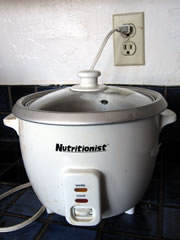
Another day, another broken gadget. Plastic-free rule #1 when something breaks is to try and fix it instead of replacing it. But that’s not always easy since so many appliances are built to be tossed instead of repaired. Well Easy Schmeasy. Fixing things is fun. Saves money. Makes you feel like a Super Hero instead of a victim. A few weeks ago, I got to don my cape again after Michael plugged in the rice cooker and nothing happened. The light didn’t come on. The element didn’t heat up. The rice did not get cooked. But the wheels in my brain started turning.
(And before any of you leave comments about how we don’t need a rice cooker and could easily cook rice on the stove and here are the instructions how to do it etc etc… yeah, I know. But we have a rice cooker. And we like it. And this one broke, so this is how we fixed it.)
See, back in 2008, the same thing happened to my hair dryer, and my dad helped me out with that situation. After testing the circuits with his multimeter, he determined that the machine’s “thermal cutoff” needed to be replaced, and we visited an electronics shop, bought the part, and replaced it. This time, though, I didn’t have access to my dad’s know-how or multimeter. So I searched Craigslist to find someone who could help. This ad caught my eye:
DID YOU D.I.Y. & GET INTO A JAM? CALL AL (berkeley)
Well, I hadn’t DIY’d yet. I was hoping to find someone to help me BEFORE I got into a jam. The ad described Al’s handyman skills… electrical jobs, carpentry, plumbing, even organic gardening. But this was the part that hooked me:
“A LIFELONG RECYCLER / REUSER OF SOUND USED MATERIALS WHEN AT ALL FEASIBLE. I PREFER TO REPAIR RATHER THAN REPLACE, WHEN AT ALL POSSIBLE.”
Me too! I contacted Al and related the story of my dead rice cooker. He came over with his multimeter to check it out. Al figured out that just as with my old hair dryer, the “thermal cutoff” (or fuse) needed to be replaced, and following his instructions, I was able to take over the job and purchase and install the part.
Of course, I took pictures every step of the way to share with you. So, here are the complete instructions, with illustrations. Keep them in case your rice cooker (or other electric appliance) suddenly stops working and you don’t know why. They could come in handy. And please, if any of you electronics geeks out there notice that I’m using the wrong terminology for some of this stuff, please let me know!
How to Fix Your Rice Cooker When the Thermal Fuse Breaks
1) Tools: Here are the tools I used for this job: Needle nose pliers, screwdriver, and metal cutter. (Note: If you have actual crimpers and want to replace the crimp connectors and know how to do it, you probably don’t need these instructions anyway. I used needle nose pliers and re-used the original crimp connectors.)

Al’s multimeter, which I forgot to take a picture of. But here’s a photo from the web:

And of course, Craigslist. Craigslist is a great tool whenever you want to avoid buying new plastic.
2) Unplug rice cooker from wall. (Do I really have to say that?)
3) Unscrew bottom screws and remove bottom.


4) Check to see if there is a thermal cutoff. A thermal cutoff is like a fuse. It breaks if the temperature in the machine goes over a certain threshold to prevent the machine from catching on fire. Al pulled back the loose insulation covering the wires to find the thermal cutoff lurking inside.

5) Use the multimeter to test for continuity from one side of the thermal cutoff to the other. Read these great instructions for how to use a multimeter and how to test for continuity. Basically, you turn the multimeter knob to the continuity setting, place the needles on either side of the thermal cutoff, and listen for the beep. If the multimeter doesn’t beep, there’s no continuity, which means that the thermal cutoff needs to be replaced. (There are other ways to test for continuity using a multimeter. Read the links above for more information. Or check out this article: How to Test a Thermal Fuse, which explains alternate ways to find the fuse and test it.)
(If the multimeter does beep, then you have a different problem which is beyond the scope of these instructions. Basically, I have no idea.)
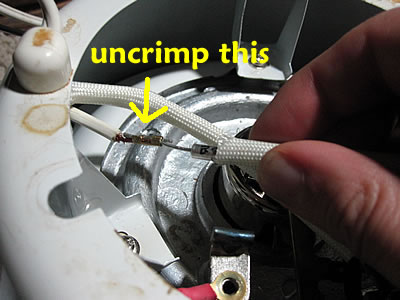
6) Remove the thermal cutoff. In my rice cooker, one end of the cutoff was attached to one of the rice cooker wires with a metal crimp and the other end was crimped to a ring terminal and screwed onto the machine. Unscrew the ring terminal.

Uncrimp the other end and remove thermal cutoff. How you do that depends on the type of crimp, I guess. Mine is metal, and Al easily pried it apart and pulled the end of the thermal cutoff out of it.
7) Buy a new thermal cutoff. Call electronics stores and read them the numbers printed on the used cutoff to find out if they have the part you need. The most important number is the temperature. I bought mine from Al Lasher’s Electronics in Berkeley. Yes, it came in a plastic bag. But compare this plastic waste to disposing of a whole rice cooker. Big difference.


8) Disconnect the ring terminal from the old thermal cutoff. I just pried open the b-crimp with a screwdriver.


9) Bend both ends of the brand new thermal cutoff into a narrow U shape and trim off any excess with the metal cutters.

10) Fit it back inside the metal crimp connector and squeeze shut with the needle nose pliers.


11) Replace the other metal crimp connector around the other end of the thermal cutoff and the wire it was connected to inside the rice cooker.


12) Replace the wire insulation.
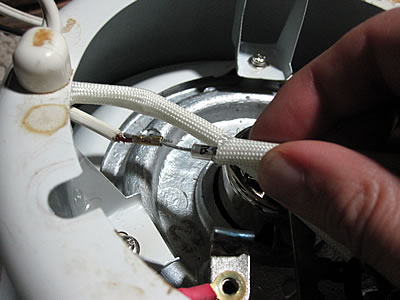
13) Screw the ring terminal back on.

14) Replace the bottom of the rice cooker.

15) Plug it in. Let there be light!

And of course, heat. The rice cooker works! Hurray and thanks to Allen Macri for all his help. If you live in the Bay Area and need the services of a handyman who is also an organic gardener and reuse advocate, contact Allen. ajpmac [at] comcast [dot] net or 510-815-7152.
The latch broke on mine. Trying to figure out how to fix rather than replace. Thank you for your detailed instructions and plastic free lifestyle!
this wasn’t related to my issue but I appreciate others fixing “disposable” household electronics. great job!
How do I fix the plastic case around where the light goes on,on my rice cooker or where can I get the piece
did you ever find your piece of plastic?
Man my mom have a rice cooker that we use for a long time but suddenly it doesnt work, there isno light, so I check the power chord and it was fine, then I check the fuse, but I cant find where it is. The model is. JNP tiger white floral one. Please help cuz I dont wanna throw away.
u can find fuse after the terminal to where the power cord is connected. Usually the current will go pass there first on one terminal / line before going to the system. It is usually hidden in an insulator just like a wire but it is usually more thicker.
Hi, I have a mini portable rice cooker that died just like this. But there is no way for me to unscrew the bottom like shown above as I can’t see ANY visible screws. What should I do?
Try pushing on all the labels on the unit. Typically manufacturers hide screws holders underneath in the interest of aesthetics.
Thanks for posting this. I have a Salton rice cooker that looks about the same as yours. I took the bottom off and am about to get my multimeter… hoping to avoid getting a new rice cooker!
Hello i have fuzzy logic rice cooker amd stop working it wasnt that old, can someone tell me whats wrong or dies can still be fix like this method that posted?thanks
Thanks for this posting. My Aroma professional multi cooker stopped working and I was have been at a loss as to what to do. Will try this and hope for the best.. thanks again!
I have a Buffalo ERC-18 rice cooker, and it shows E01 error. After I replaced the fuse, it still shows E01 error. What else should I need to check or replace?
I have same problem . My 10 cups Buffalo smart cooker not working . It also show E01. Need help
My riceckooker turn of autometically after2 , 3 minits and restrat autometically after 2 , 3 minits.. why my rice cooker not working properly.
I have a 2 tier Oster food steamer that no longer will heat & steam the water. I figure it may be the heating element that must be broken. I really enjoyed having it. It has clear plastic baskets that fit on top of the steam plate that holds water . Can you help me?
Put an ad on Craigslist for someone to help out. That’s what I did. I am not an expert. 🙂
I know I may adding this a little too late. But I had the exact same problem followed by another problem.
A slightly different problem is that after replacing the thermal fuse, my cooker was always warming. The switched worked to go to COOK position. But it was still warming only (low heat only).
The cause is mechanical. You see, most Chinese made rice cookers have a mechanical contraption which does the following: 1. If the weight is more, then underneath two almost flat rectangular panels (usually one on top of other) should touch each other. This is the COOK (red light) case. This should be the case when we have both rice and water in the pan. 2. If the weight is less (assume rice is cooked and weight has decreased), then the rectangular metal sheets should not touch each other. This is the WARM state. The two panels can be identified by the typical TOUCH point (looks like a small button on one panel and on the other panel a small concave opening to accept the button. Open your rice cooker and see if this metal/mechanical contraption works as it should. The panels are usually bendable (thin) and you can experiment. Once you set them in a way as described, your rice cooker should work now. Of course, I am assuming that if you had had the problem shown in the Beth’s post (thermal fuse issue), you had already fixed it.
Hope this helps someone NOT to replace their cooker 🙂
NOT TOO LATE, JASMINE! =]
I just stumbled into this discussion after struggling with a faulty rice cooker for several months. Sometimes it turns on, sometimes not… The symptoms are exactly as you describe, so I will investigate according to your suggestions BEFORE I try replacing the thermal fuse.
Assuming this Comments section will allow it, I’ll report back on my findings. Thanks for taking the time to post additional information, and thanks to the author of this very helpful blog article.
you should replaced it with the right thermal fuse 195deg, 110v if you are in us, 250 v if asia 15 amp, if it doesn’t work you have a different problem, there is another resistor with wires if that is open you can’t warm up the rice but it will work on cooking, good luck guys
i am very grateful for this post,it has really helped me fix my rice cooker on my own which stopped functioning several months ago.
I have a Sharon’s m18 c model rice cooker looks like the circuit is gone all micro switches or membrane type it just wouldn’t start need help can such membrane types be repaired
Thank You.. Just got it Fixed and there was light.lol. You really helped a lot.. Cooking my rice now..
I just learn about thermal cut off from you. Thanks 1000 times!
God bless you sir
If the reading is zero would that be still good for thermal fuse or not ? I believe if is open bad fuse no continuity. Is that right?
Thanks, I saved one of our rice cookers after reading your information. Thanks a lot. Now it is working perfectly well.
I need help.
My rice cooker is always on warm. You press to cooker and it will return to warm again. Possible solutions please
me too. I don’t know what to do
dude, i replaced the new thermal exactly the same as the original one SEFUSE BF-188E 192C – 10A , JET 250V but it blowed after 10mins of cooking.
Please let me know what happen?
many thanks.
Have the same problem and still not find what happen.Please let know what happen.
Thank you! This post saved our cooker. After almost a year collecting dust, my dad and I finally got around to fixing my rice cooker by replacing the thermal fuse. He ordered through Amazon (10 for $4.99) shipped directly from Hong Kong and arrived weeks before expected date.
So glad to have my steel-pot cooker back and not in landfill. Not to mention the cooked rice!
No need to use the fuse agin. I use few copper wires similiar to that. Also direct soldering also ok
Dude…that will overheat the cooker and burn you rice. Damn!!
That defeat the purpose of safety. Next time when the cooker overheats. The circuit won’t break. You burn the rice, rice cooker, the kitchen… you got the idea.
thnx. This is a big help. 5 star
It worked perfectly for me thanks. You are God sent , you took so much trouble in explaining perfectly you deserve no less praise. May many more people be inspired to post similar fixes bless you
Palani
Hi,
I recently fixed my mom rice cooker using the steps you have illustrated above.
Thanks and god bless.
Shah
Hi,
We use two large rice cookers in our Hawaiian BBQ restaurant everyday! I was happy to find your excellent article that allowed me to fix our rice cooker. The person at the electronic store told me it makes a difference which way the thermal cut inserted. Perhaps this will help John.
Regards…Humphrey
Hi,
I got my thermal cut off replaced by an electrician..but soon after replacement the cooker started to trip from COOK to WARM after 10mins and again when I try to set it to COOK it will happen only after sometime i.e., when the cooker gets a bit cool.
Pls help me with the problem because the electrician himself is saying he has no idea what is the problem so I have to fix on my own.
Thanks,
John
I have the same problem
How did it work out without the thermal cut off? It’s kind of dangerous to do that. Could catch on fire.
I’m sorry, I don’t know. I would look for an expert like I did to ask for help.
I’m sorry. I’m not an electrician. If I were you, I would find someone to help, like I did. The thermal cut off is there to keep the unit from catching on fire if it overheats. If the thermal cut off blows right away, then there must be something else going on with it. I wouldn’t use it without that safeguard in place.
That’s exactly my goal… to keep perfectly good gadgets out of the landfill. So glad the post helped!
Thanks for the detailed explanation, i bought a new thermal cut off for 2 $ at radio shack ( Pretty expensive ) .. Mine was 184 C standard but i used a 229 cut off fuse.. still worked neat..
Your post saved the rice cooker from going permanently to trash.. Keep sharing knowledge..
Regards
Natarajan
I had replaced the thermal cut off and the cooker worked only for few minutes only. The thermal fuse is blown again. Now I have connected directly without any safety thermal cut off and cooker is working fine.
Why thermal cut off blowing ooften?
Is there any re settable thermal cut off?
Hi,
I like your explanation. My rice cooker hard this problem and getting that fuse is impossible. I tried to fix it by connecting direct wire over the broken fuse, it cooked only once. From there, soon after plug in it cooks for few seconds and shift to warm. Is the problem caused by direct connection over a broken fuse? Thank you
wow..thanks for this..by the way..the thermal fuse of our rice cooker is toasted lol..and the problem is there is no availble store here(midnight) so i just connect the wire without thermal fuse.i’m planning to buy it tomorrow after work.. can i use my rice cooker for once or twice..dont have time to cook on stove..
Besides precise instruction you gave us a great presentation style along
Ahhh, this just happened to my rice maker. Great pics and good info.
So, I needed a Microtemp Cutoff SF226E 227C 250/10A for my rice maker. Black and Decker.
I live in Hawaii so no REAL electronics store besides radio shack and of course they don’t carry it. So, I’m looking at 3-4 months shipping slow cheap economy mail from Hong Kong. I did mention we eat rice every day?
SO! I’m not recommending this to ANYONE and if you decide to do it … DO IT AT YOUR OWN RISK… I just ripped that POS out and replaced it with #14 stranded wire electrical extension cord.
EricLp
Hi Eric Did you fix it or do you still need that fuse?? I am going to my electronics store today–the rare and old fashioned kind that smells like cardboard boxes full of components. I will ask them if they have that part and if it costs less than a dollar, I will buy it for you and send it to you today. I really hate being ready to fix something and then not being able to find the part.
If I am successful, I will send another reply to your post with my email address so you tell me how to get it to you.
Sarah
Microtemp Cutoff SF226E 227C 250/10A
ariang555 Loving my multimeter That’s very useful information. Thank you for sharing!
Loving my multimeter I will assume that someone with a multimeter knows that diodes only pass current in one direction, but the average reader may not know that. So, before any DIYers out there take it upon themselves to replace diodes, make sure you have tested the diode continuity in BOTH directions. (put red test lead on one side, black test lead on the other side and test, then reverse positions of the red and black test leads and test again) If a diode is good, it will pass current in only one direction. If a diode is bad, it will not pass the current in either direction.
hey bro you just made my day, guys like you are great, i love to do things myself rather then giving it to these service centres. who charge you a bomb for their service, small things which you can do it your self makes sense to do at home, complicated stuff then seek the pros.
Thank you so much! What a fantastic step by step tutorial. You really did a great job and I just fixed my rice cooker by following your steps exactly. My friends and even the hardware store clerks told me it was too much trouble to find the fuse replacement and just to buy a new rice cooker but it would be so silly to throw out the rice cooker when it just takes a 15 min fix!
Thanks again – luv your website.
Hil
Wow! That’s a real cool tutorial! I would definitely try it out on our home’s rice cooker!
Thank you for the superb tutorial! I have just managed fixing my rice cooker! I thought I could use my engineering skills and try 😉 I just couldn’t figure out what the problem was, thanks to your pictures I discovered the fuse! and I thought it must the fuse, everything else looked good. I didn’t have a multimeter so I took a chance and replaced the fuse 😉 and VOILA! it worked! I reused a fuse from another old rice cooker where the teflon in the pot started coming off and sticking to the rice.. so that’s health hazard.. so I combined the two and got a perfectly functioning rice cooker!
Cheers from Sweden!
Many thanks! I live down the road in Union City and needed to fix my rice steamer. I found the part at Fry’s for under $2 and it now works fine. Great article!
In my case my rice cookers thermal fuse was fine – the DIODES in the the wires that lead to the light bulbs were in need of replacement. How did i know? 1) I tested the thermal fuse as this web page suggested. The continuity test for all wires came back with a beep including the cord that plugs into the wall outlet. 2) i tested each wire length individually and the only 2 that did not beep were wires that lead to the light bulbs (that light up the “cooking” , “warm” or “done” indicator lights). 3) I noticed that the 2 sheathed wires that had not continuity had strange bumps along their lengths. I cut the sheaths off and the “bumps” turned out to be diodes (diodes cost pennies to replace) 4. I tested for continuity along the wire both before the diode (BEEP!) and after the diode (NO BEEP!).
I’ll be replacing the diodes to make sure that this indeed is the problem but the internal mechanisms in a rice cooker are surprisingly simple (even for me who is an beginner when it comes to electronics at best). There are only so many things that can break or wear out. I’m confident that this is the cause. I ran a continuity test on other diodes i have (for another project) and they beeped so i’m 99% sure this is the problem .
Thank you for this page! I hope that my information helps others as your information helped me 🙂
how much it cost if we give to customer serviuce for repair?
My waffle maker had the same problem. Matter of fact 99% of these electric appliances have a thermal fuse which seems set to blow and make us buy a new one. Coffee makers, hair dryers, frypans. Ha Ha! Costs all of $1.98 to buy a fuse. I bought three just in case…two left over.
Thanks for the excellent photo and explanations.
Junior Mr. Fix It – Chicago
Thank you so much, truly a genius
wow this is cool….now i can fix my rice cooker.
thanks a lot @Beth Terry.
Freddy, glad to confirm your super-hero status. 🙂
I was searching for exact the same info and this was the best instructions (with lots of pictures) I could ever find on web! Thank you for the great work. Much appreciated!
what is that inner pot made of? hate teflon, aluminum. anyone know if “green pans ” are really safer?
This one is aluminum. I’m not crazy about that fact either but can’t bear to get rid of it since I already have it. There IS a rice cooker with a stainless steel pot inside. Google it. (I gotta run or I’d find the link for you.)
One day, my stereo wouldn’t turn on. Perhaps needing the same repair as the rice cooker? I hope!
Thanks!
Inspiring story + practical how-to info–you don’t get both in a single post very often these days, so thanks for sharing. I just went through a similar ordeal with my blender, but when I took it apart I found several small PLASTIC pieces inside hopelessly broken. So rather than go out and buy what would be about our third contemporary blender in as many years, I dug around in the basement until I found my wife’s grandmother’s all-steel-and-glass Osterizer, circa 1960. Works like a charm. No plastic, no problem!
…jumping up and down cheering… Go Beth, Go Beth, Good job, Beth! I”m definitely going to save these directions, in the event my rice cooker gives up the ghost. (or any other small electric w/similar heating elements, like my yoghurt maker, maybe?).
It’s good to know about Allen — I’m saving this post in case we ever need him to help us repair to re-use something.
Unrelated to this topic, I wanted to thank you for publicizing Annie Leonard’s The Story of Stuff and Susan Freinkel’s Plastic, A Toxic Love Story. I was able to get both of them through my local library. They make a good combination of reading material and have taught me more about various forms of plastic. I highly recommend them to your readers and others.
Beth, that is so cool! I’m impressed, and inspired to try the same, as I’m normally completely flummoxed by broken electronic items but loathe to throw them away. Thanks for sharing such detailed instructions. I don’t own a rice cooker, but some of the principles will be the same.
I love reading stuff like this. We’ve been trained that it’s easier to throw something out or that it will be too difficult to fix it. I’m so pleased to read your adventure of meeting Al and then fixing your rice cooker for $5! Good going Beth!
You never cease to inspire! I like to fix things, but electrical fix it jobs are intimidating.
You (and Al) are awesome. So hard to get things repaired these days — maybe we all need to get a bit handier.
Big applause to you! I’ll remember to come back to this post when our old rice cooker goes out. 🙂
Its like you were meant to meet Al, so your rice cooker was menat to break! It is so great to see that these things canbe fixed, my DVD player just stopped turnin on but it makes a noise when plugged in, maybe there is hope for it yet.
Congratulations! I’m definitely in the why-on-earth-would-anyone-want-an-appliance-like-a-rice-cooker-cluttering-up-their-kitchen crowd, but nevertheless, I’m very happy for you.
That’s much cheaper than buying a new rice cooker! My hair dryer broke in the spring and I threw it out because I had another one (backup!). Now I wish I had kept it and fixed it 🙁
Wow Beth! I am so impressed that you were able to fix it!
From business school, I learned that many products are made with short lifespans purposely so that consumers will replace them year after year. They are made to work long enough so that the consumer will learn to love the product, but not too long so as to stop sales. But sometimes the $7 toaster from WalMart can outlive the $40 one… it’s just a matter of durability and fixing the weak parts. Most people don’t bother because the time and money it takes to replace parts. By the way, how much did the thermal cutoff cost you?
Sabrina, I think it cost about $5. I know I could have found it a lot cheaper if I’d ordered online. Of course, there would be shipping added on, so it wouldn’t have been that much cheaper. And ordering online means more packaging and fuel for transport, so I’m happy to have bought it locally.
Dad, who’s your boy? Are you having gender confusion?
Holly, please try it and let me know if you fix it. And seriously, take pix okay?
Beth you are such an inspiration!! I have a 1950s era waffle iron that stopped working, but I love it too much to throw it away. I’m going to take it apart and see if it has a fuse!
That’s my boy! Way to go, BGT.
Way to go!!!
Love it! I’m secretly hoping that some electrical gadget of mine will break just so I can fix it 🙂
Hi, I was just wondering if anyone can guide me on de-crimping the metal crimps on the ends of the thermal cutoff. I’m having a hard time trying to pull it apart. Is there an easier way to do this?