



Hidden Plastic
A lot of plastic hides in objects that many people don’t realize contain plastic: plastic that coats and lines cartons and cans and caps and lids. Plastic that can’t be separated from the material it’s attached to. Here’s a rundown of some of them.
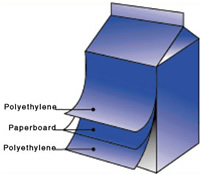
 Paper milk cartons are lined with two layers of polyethylene, inside and out. Many people are under the mistaken belief that these cartons are waxed. In fact, although the original paperboard milk cartons were coated with paraffin wax, they haven’t contained wax since the 40’s when polyethylene became the waterproofing material of choice.
Here is a diagram of how they are made, directly from Elopak’s web site.
 The point is that if it’s made from paper these days, and it holds liquids, it’s generally going to be coated with plastic. As far as I know, there’s no ice cream container that’s not coated with a petroleum-based plastic, although there are manufacturers experimenting with bio-based plastic coatings.
 So choosing paper cups and paper plates does not necessarily mean plastic-free. Cups are always coated with a layer of polymer film to make them waterproof. Plates may or may not be coated with plastic. You can tell if they are shiny or not and if wet food soaks through them or not. Georgia Pacific’s Dixie Brand (pictured) contains a “Soak-Proof Shield.” Their site does not reveal what the shield is made from, but you can be sure it’s plastic.
 There is a new paper cup being used by Tully’s and a few other coffee houses called the Ecotainer. It’s coated with NatureWorks PLA, a corn-based plastic, rather than petro-plastic. Hopefully, this is just the beginning of new, more environmentally-friendly options, as they are fully compostable (the cups, that is; not the lids.) Still, disposable is disposable; NatureWorks PLA is produced by Dow Chemical and Cargill; growing corn in this country, most of which is GMO, is fraught with its own environmental hazards; and bringing your own is always the best choice.
 Moving on from paper products, we come to cans. There’s been a lot of news lately about the fact that most food cans are lined with polycarbonate, which has been found to leach Bisphenol-A. And the few BPA-free cans are lined with another kind of plastic coating. So buying canned foods is not a way to remain plastic-free.
 Neither is buying canned soda! Aluminum soda cans also contain a BPA plastic lining to prevent the soda from reacting with the metal. See for yourself in Steve Spangler’s Inside The Soda Can demo.
 So, what kind of food container is really plastic free? Glass? Not quite. The lids of glass jars are lined with plastic as well. Some Mason jar lids don’t seem to contain plastic, but all of the twist-off ones do. See my discussion of the differences between jar lids.
 And metal twist off caps are not plastic-free either. This photo shows a twist-off wine cap. Wineries have been switching to these lately as an alternative to cork. However, these caps are lined with PVDC, a possible hormone-disruptor, which is yet another reason to stick to natural cork stoppers, especially since producers are taking new measures to make sure natural corks do not develop mold.
Confession: I do indulge in the occassional pint of Straus’s local, organic ice cream, and I do use glass jars with those plasticized lids.
I’m not listing these things to scare you or make you think you have to avoid everything. But I think it’s a good idea for us to be mindful of all the plastic we use every day and to try and minimize our consumption as much as we can. I always think it’s better to be educated than blissfully ignorant.
Every item on this page is either recyclable or compostable where I live in Oakland, CA. The question to think about is what happens to all that plastic? As we know, it doesn’t biodegrade. It’s all still out there somewhere, even if the metal has been made into new cans, the paper has been pulped into new paper or broken down into new soil. The plastic’s still there in our environment. I don’t know the ramifications of this fact. But I do think it’s important to keep in mind.
Not all ceramic contains lead, some glazes do but some don’t, and stoneware ceramic is lead free.
Hi,
I am working on a project with my class of 10 year old students and we are investigating the use of single use straws which come attached to their flavoured milk and juice cartons. I know the cartons are not a viable material either, but we are focusing on trying to eradicate the use of straws in our school by implementing an action research plan. Do you know of any companies that provide small kid-sized juice boxes with biodegradable straws? Alternatively, do you suggest any other options that are easily implemented into a school setting/tuck shop setting?
Thanks in advance,
Kat from Australia
So If you really want to be poison and plastic free you must find a virgin planet in a galaxy far away, cause this ones gonna stay contaminated till the sun blows up. Hard to believe it only took 150 years to **** it up!
What disturbed me most today in my search about BPA’s and phtalates, is that is seems that especially hospitals are dealing large amounts in bloodbags, intravenous apparatus, respirational equipment & so on. Also some pills with for instance omega3 have high phtalates content.
I’m trying to find out if buying butter beans (for example) in cardboard cartons is safer than buying them in cans. I thought that the cartons would be safer but now I’m not sure. Does anybody know please?
My suggestion is to grow the beans yourself And preserve them in a way you would think is the best choice
I really don’t think u can get away from all this plastic coating and I drink from paper cups at work so I am putting all this crap into my body. I thought about bringing in a ceramic cup but cause its a hospital environment I don’t think this would be allowed!
Consider that even when they were waxed, it was probably paraffin-based wax and therefore petroleum/plastic even then.
I am thinking that the butcher paper with the shiny side is probably plastic, eh?
Kathleen
Yep. The shiny side of butcher paper is plastic. But there is also uncoated butcher paper.
Gees….. lids from glass jars…. ?? ” Wax” on paper. More food for thought.
Thanks for promoting the use of cork. Portugal being the biggest exporter of cork can really do with the business. Also, the trees are beautiful & cork is completely sustainable. The trees don’t get cut down, they just have a “hair cut” every ten years. Natures magic. I never knew that before I saw them. (you probably do)
But sometimes you don’t know until you open the bottle & they surprise you with a plastic “cork”. It should have to be labelled.
Thanks so much for pointing me to this post. The milk carton thing is a revelation, although not a surprising one. And I’m not just being cynical… I’ve always sworn that milk in anything but glass tastes like plastic to me. I seem to have very finely tuned plastic taste buds because I can taste the plastic in any liquid that came out of a plastic container (with the possible exception of something like soda or juice that already has such a strong flavor.) I’ve always refused to drink bottled water unless it was Perrier or something in glass because I could taste the plastic. People tend to think I’m nuts on this front – well, probably on other fronts too… but who knows, maybe I’m like one of those cancer sniffing dogs or something!
I still haven’t decided if I’m going to include the catfood cans in the tally or not, but even without them, I’m already horrified by day one! I’ll keep you posted…
I only like very weak tea and I can taste if the water was boiled in a plastic kettle especially if it was boiled and left to stand.
I’m reading in on BPA and phtalates, and … well, as long as the milk is not obtained by hand …. be sure the phtalates levels are very high, meaning that before it hits the bottle, it’s being transported and pasteurized, mixed etc, in probably loads of plastic (lined) containers and pipes :o/
hey do you by chance know the difference between waxed paper cups and plastic lined paper cups? because i’m doing a science fair on it and i want to know the difference