



It’s plastic! Evert Fresh is made out of plastic!
Read 12/20/2007 update to this post here.
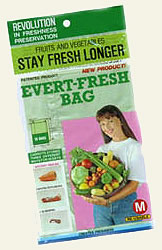 Sorry to go all Charlton Heston on you. It’s just that, based on several blog posts I’ve read, a lot of people seem to think that Evert Fresh green produce bags are plastic-free, and they are absolutely not. After calling the company several times a week for over a month to try to reach the owner, Lynn Everts, I finally received the information I needed today from his assistant, Tyra. She told me that the bags are indeed made from low density polyethylene (the same type of plastic in disposable grocery bags) combined with a special clay called oya which helps to keep produce fresher longer.
I have no doubt that these bags work. But I find it ironic that we would choose to purchase an ultimately disposable plastic bag (these bags can be reused up to 8 times) made from a material that lasts forever in the environment in order to preserve something that is completely biodegradable. Personally, I’d rather buy my produce more often and be careful to eat it in a timely manner than purchase brand new virgin plastic bags to make it last a little longer. And I’d rather compost the few produce items that do go bad than landfill plastic bags.
Others may feel that saving produce is worth the plastic. And that’s their choice. My problem is that folks who believe they are avoiding plastic may be purchasing these bags because of the way they are described on various web sites. On Amazon.com, two sellers, Greenfeet and 877myjuicer, list them as being made from “non-petroleum based materials,” while seller, Showcase, claims they are “made from all-natural, environmentally safe materials.” These claims are simply not true, and I have e-mailed Amazon to find out how to go about getting the descriptions changed.
It’s one thing for Amazon to be selling plastic bags, but it’s quite another for Reusablebags.com to promote and sell them. No where in Reusablebags.com’s description of these bags is it revealed that the base material is actually plastic. The write-up only states that the “active ingredient is a natural mineral” and further down the page proceeds to describe the mineral as a clay called “oya” which absorbs ethylene gas given off by produce as it matures. Since Reusablebags.com is a site devoted to eliminating plastic bag waste, it would be natural for a customer to assume the Evert Fresh bags were not plastic. So I’ve also e-mailed Reusablebags.com to request they update their description of this product so that their customers can make informed purchasing decisions.
Representatives from both Reusablebags.com and Evert Fresh have told me that the bags are recyclable. However, reps from neither company could provide the names of recyclers or recycling programs that would accept them. So I checked with three of my recycling insiders, and all three felt that the clay used in the bags to keep the produce fresh actually makes them a contaminant in the waste stream rather than a recoverable material. They would probably be weeded out and landfilled by plastic bag recyclers.
So, how do we keep produce fresh without plastic? It’s a good question, and I don’t have all the answers. At the farmer’s market where I table with Green Sangha, we distribute organic cotton Eco Bags, which can keep many fruits and vegetables fresh in the refrigerator if dampened. However, this past Sunday, a customer told me she’d not had good luck with loose leaf salad greens. The cloth bag couldn’t do as good a job as plastic. Any suggestions from plastic-free salad eaters?
Another customer asked me about carrots, and I did have the answer to that one! Carrots last a really, really long time if you keep them immersed in a container of water in the fridge. I like to replace the water every few days. I think this works for celery, too.
We keep apples, pears, and citrus loose in the refrigerator without any bag or container. Tomatoes and avocados stay out on the counter. Bananas stay out on the counter too but tend to turn brown pretty fast. Most other vegetables and fruits are in the dampened cotton bags in the refrigerator.
So, what are your tips for keeping produce fresh? The clay sounds like a good idea. Too bad it’s attached to a bunch of plastic.
I will definitely be trying the mason jar suggestion for greens. I’ve seen the articles about “salad in a jar” and always wanted to try it.
Right now I wrap lettuce in an old linen sheet I cut up and hemmed to make several towels and produce bags, which I use at the market. The rest of the produce I either keep open and loose in the fridge and use ASAP or store in mason jars. If I shop at Rainbow, I use their compostable bags. The Evert bags are definitely an improvement over the produce bags at the markets, so no judgment from me. Anything that moves away from a one-use item is an improvement. They do seem like a great produce bag to use at the store.
@Pro Evert Fresh Bags Y buy them if you’re not going to reuse them? Seems like a silly expense.
I always find it amazing that the aggression comes from those who are “disposers”. The idea I thought was to educate, not abuse others. If you want to use disposable things then fine. But I like to avoid plastic disposable items so like to be informed. On the subject I like to use open containers with a bit of water in them for salads, anything reusable. I like to see what I have, lets everyone pick at them and use everything within a few days. Did you know a porous clay pot DOES work wonders? Like the garden pot but without a hole. On a cellular level, greens die even if they still look fresh. The longer they are left the more dead they are. So fresh is best, ideally being eaten within 3 days. Education is key, not just in storing but organising time, amounts to buy, cooking etc..
How about FreshPaper? I haven’t tried it out yet, but it looks very promising! I think it’s sold in stores on the East Coast only, but the company ships all over. (www.fenugreen.com) The main ingredient is fenugreek, so I may just experiment with using that spice to preserve my produce.
Hi jeanb. I actually sent an email to fenugreen a couple of days ago to find out what it’s packaged in. It’s some kind of brown plasticky looking packaging. Could be cellulose. I don’t know. If it doesn’t come packaged in plastic, I will try it out.
You are awesome! I am totally addicted to your blog! You have opened up my eyes!
thank you for posting this article. I thought these bags were not made out of plastic. Your blog has educated me a lot about going plastic free.
for the people that are complaining about this article remember you are on a blog that is trying to cut plastic usage.
These bags work for me for a few reasons. First, I don’t live close to my grocerry store, so it’s not feasable for me to go shopping everyday, and if I did that would be a lot of gasoline use. Second, I take these bags to the store and use them as my produce bags. Third, I find they stay useful for way more than 8 uses. I only replace them every few months.
I think if we use the base material as jute, and then add a fine layer of cotton mixed with that special type of clay on both sides. We will have a winner.
btw, hi all I’m from India and I hate plastic
PS: Papier-mache with clay can also be good, and with the inside as jute, its totally biodegradable
Maybe if enough people express concern, Reusablebags.com will update the information on their site. You can help by e-mailing them at service@reusablebags.com. Please feel free to e-mail me and let me know if you have contacted them and what the result was.