



Store Report: The Thing About Costco…
In last week’s post about tips for shopping at Safeway and other mainstream chain grocery stores, I mentioned that one way to save plastic is to buy large-sized containers. Sunny commented that for that reason, maybe shopping at Costco is not so bad. So tonight, I visited Costco with my camera to see if we really could save plastic by buying large containers there.
What I found is that yes, if you don’t have access to a store with bulk bins, you can buy large bags of rice or beans or large containers of laundry detergent or ibuprofen and save some plastic. But the thing about Costco is that most of the merchandise is not packaged in large single containers. In fact, if you’re not careful, you could end up with way more plastic from Costco than you would otherwise. For one thing, most “bulk” purchases are actually plastic-wrapped bundles of smaller items:


 It doesn’t help to buy products in plastic containers that are joined together with plastic wrap or bundled in plastic blister packs. You’re still getting the same amount of product as if you bought the individual containers separately. The difference is that you’re also getting the extra plastic outerwrap. Inside each jumbo pack of toilet paper or paper towels are several smaller plastic-wrapped packages. It doesn’t help to buy products in plastic containers that are joined together with plastic wrap or bundled in plastic blister packs. You’re still getting the same amount of product as if you bought the individual containers separately. The difference is that you’re also getting the extra plastic outerwrap. Inside each jumbo pack of toilet paper or paper towels are several smaller plastic-wrapped packages. |
 Another thing about Costco are those ubiquitous large blister packs protecting very tiny items. The store’s got everything from gift cards and SanDisks to postage stamps and FasTrak bridge passes locked in those things! I figured Costco used them for theft control to keep people from pocketing the smaller merchandise. That reason wouldn’t make me any more inclined to buy an item in a huge blister pack, but at least I can understand the logic. Another thing about Costco are those ubiquitous large blister packs protecting very tiny items. The store’s got everything from gift cards and SanDisks to postage stamps and FasTrak bridge passes locked in those things! I figured Costco used them for theft control to keep people from pocketing the smaller merchandise. That reason wouldn’t make me any more inclined to buy an item in a huge blister pack, but at least I can understand the logic. |


 Then I saw what I thought were rows of blister-packed iPods:
 But upon closer inspection, I realized that all these plastic packs were actually empty! A little sticker on the package says, “To purchase your iPod, please present this empty package at the register.” So why do these empty packages have to be packaged in plastic? A simple cardboard card wouldn’t suffice? I should have asked an employee what happens to the empty iPod blister packs after the iPod is purchased. I’m assuming they can’t be put out on the shelf again if they’re being used for inventory control. Or are they? Anyone know?
Plastic at Costco. Plastic galore. But wait. There’s even more! Unlike most regular grocery stores, Costco packages most of its produce in plastic containers, too.
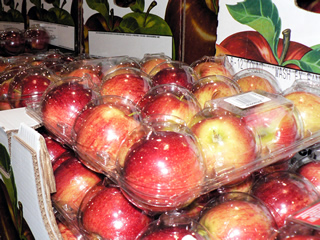
And if you look up and down the overwhelming rows of merchandise, the one thing each aisle has in common is the plastic wrap surrounding every palette of goods:


 And here’s a photo I thought I’d throw in just because. I felt like a little spy tonight creeping around with my camera and waiting until employees left the areas to snap my pictures. I took this one in the seconds before the guy returned to his cart with more trash.
So what’s the moral here? If you are truly disciplined and you really have no way to buy the products that you need plastic-free, you might save some plastic by buying them in large containers at Costco. But even then you need to be careful! If you buy a container that holds more than you can actually eat (or more than you actually should eat) you’re still not saving plastic in the long run, are you?
A few years ago I read a news story describing a study that related the size of the container to the amount a person ate. According to a University of Illinois study:
External cues such as packaging and container size can powerfully and unknowingly increase how much food a person consumes. Do they still, however, stimulate consumption as the perceived favorability of a food declines? This was examined with popcorn in a theatre setting. Moviegoers who had rated the popcorn as tasting relatively unfavorable ate 61% more popcorn if randomly given a large container than a smaller one. Moviegoers who had rated the popcorn as relatively favorable ate 49% more when the container size was increased (and were likely to eat greater amounts if accompanied with a person of the opposite sex). One reason for this increase was that consumers had more difficulty monitoring how much they ate from large containers.
And I would add that you’re probably also doing so at the expense of extra plastic. So for the most part, I think Costco is a trap. Even I didn’t get out tonight without buying a couple of things: 2 bottles of wine and a big hunk of cheese. Oh, and a slice of pizza. I do love that greasy, cheap Costco pizza. Talk about calories! Believe me; I won’t be going back again any time soon!
Also, most Costco plastic packaging does not seem to have a symbol indicating if it is recyclable and the type of plastic (usually indicated by a number between 1 and 6). So all the packaging from Costco ends up going to trash. When there is a number, it is often type 5, which is not recyclable in my area
2007 to today in 2015, guess I’m a bit slow but my eyes opened to almost 100% plastic at Costco. I’ve been a member since 1988 and it is time to end it! I am shopping at Farmers Markets (eggs, fruit, vegetables), fish market, tofu factory, and buying whole grains online, storing everything in glass and freezer, frig. Bought glass pour over coffee maker, biking to buy my things…..
Michelle and Herself, I know you guys are certainly right about the plastic wrapped around the pallets. All the warehouses probably do it that way and we don’t see it.
But Costco is absolutely different from other grocery stores in how it packages everything in blister packs and clamshells and creates bulk items by shrinkwrapping two or three together. I haven’t shopped at Sam’s Club, so I don’t know if it’s the same plastic deal as Costco. I am certain that Costco is using way more plastic packaging than a lot of other stores.