



Juniperseed Mercantile Makes Great Plastic-free Products
When I start to feel depressed about the state of the world, I think about you guys, the folks who read this blog, those that I know and those I’ve yet to meet, and I realize how grateful I am to be part of this online community of people trying to make a difference. So I was tickled a month ago when Fake Plastic Fish reader Tiffany, proprietor of the shop Juniperseed Mercantile (formerly Picnic Basket Crafts) emailed me to ask some questions about plastic packaging.

Tiffany is a school teacher by profession and in her “spare time” sells healthy cleaning and skincare products that she makes herself, trying very hard to reduce the amount of plastic packaging. She doesn’t even use plastic tape, and recently posted a Plastic-Free Green Product Packaging Tutorial on her blog, demonstrating exactly how to use paper tape. But she’s stuck when it comes to containers. As she wrote me,
…I can’t seem to get around the fact that my customers’ number one priority is to be able to buy healthier alternative products which they can actually afford. I would like to use glass bottles, but the cost would become prohibitive to my customers, who will just turn around and buy a plastic-bottled product from someone else.
Instead, she offers to fill reused plastic water bottles “(gleaned from my classroom recycling bin – I would NEVER buy bottled water myself)” and to refill customers’ containers. Recently, she posted a poll on her blog asking her readers for their opinions about businesses that use plastic packaging. Over 50% of her readers voted for her to stick with plastic to keep her prices low.
This is a real dilemma, isn’t it? I didn’t have a great answer for her. But after browsing her shop and reading her philosophy, especially her shop policies which emphasize her commitment to environmental sustainability, I could tell she was definitely on the right track. Even more exciting to me were some of her products that actually solve some of my own plastic dilemmas.
My lonely Swiffer comes out of retirement!
One product that made my day was the cotton chenille reusable mop pad made to fit a Swiffer mop system. From the description:
Can you balance a clean floor with the trash created by using those disposable mopping systems? [Why no, Tiffany, I can’t!]
So if, like me, you’ve had your Swiffer gathering cobwebs in the garage [Yes, I have!] because you can’t bring yourself to use those disposable mopping pads [in their disposable plastic packaging], here’s your solution! This listing is for a set of three thick and thirsty reusable cloths made to fit a standard Swiffer or other similar convenience mopping system (the kind where you shove a corner of the cloth down into the pokey hole to make it stay attached).
Tiffany sent me a couple of her reusable Swiffer cloths to try out.
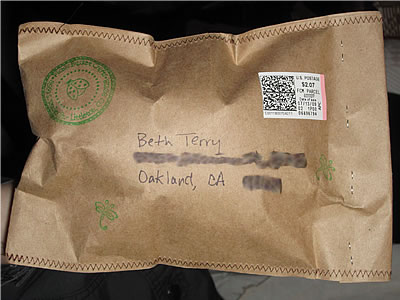
Here’s how they came packaged:
I and my floor love them!


She also makes reusable pads for other types of Swiffer systems, as well as “unpaper cloths.”
Another plastic-free product Tiffany sent me to try is her new Biodegradable Laundry Stain Bar, made from vegetable oils, sodium hydroxide, borax, baking soda, sugar, and salt.

I tried it out on a tomato-stained pair of pants, scrubbing a corner of the damp bar onto the pants before I tossed them in the wash.

Stain-free!

Meet Tiffany (Cuz she’s great!)
I asked Tiffany to tell me a little about herself and how she got started creating her own products to sell. The following is our interview. Be sure and read to the bottom for the giveaway instructions. Enjoy!
Beth: When did you start inventing and making your own natural products? How did you get started? And why did you want to make these things yourself?
Tiffany: I can’t tell you about my cleaning products without telling you a little about my Oma. Coming of age in post-World War II Germany and then moving to the U.S. with 4 kids to raise on her own, it was always just a given that cleaning products would be homemade. I grew up watching her start her day by crafting the concoctions she would later use to clean, disinfect, deodorize and freshen up the house with. She was well-known for having THE cleanest house on the military base. Decades later, when she would come to visit and ask where we kept the borax and washing soda, I’d shrug and hand her some Windex and Comet. She would just shake her head and mutter to herself in German, then proceed to dig through the pantry herself looking for suitable substitutes. Oh, the wonderful things that woman could do with a stale box of baking soda, half a cup of white vinegar, and the juice of a lemon! Well, there you go… the inspiration that made me throw out everything under my kitchen sink, and begin to ask, “What would Oma use?” Her thrifty “waste-not, want not” lifestyle also inspires many of my other crafts, and I think of her often as I am working.
Beth: When did you first learn about the problems with plastic and what steps have you taken to get disposable plastic out of your own life?
Tiffany: As a like science teacher, I feel obligated to teach my students about the impact their actions have on the environment. I teach biology through an ecological approach, so it’s something I sort of live and breathe every day. I am also the sponsor for our school’s Leadership Club, and together we have done a lot of work to make our school closer to zero-waste. We have also stopped doing preserved-specimen dissections (those preserved with chemicals and injected with latex – ewww). As a compromise, we only dissect what we can eat when we finish (lots of veggies/fruits, squid, chicken wings, eggs, etc). In my personal life, I never buy plastic bottled beverages or use plastic bags, use cloth diapers for my kids when we are at home, bring my own dishes to school and parties, use cloth baggies for lunches and snacks, and choose products with less packaging, and those which will last longer.
Beth: What challenges do you face as a shop owner between getting your natural products out to customers at an affordable price and reducing the amount of plastic packaging?
Tiffany: It is actually a lot harder than people might think. As hard as I try to minimize the amount of plastic I send to my customers, most of my raw materials come to me wrapped in plastic. I try to reuse those materials as much as possible, but for a lot of my products, I have to use new containers (and weighing cups, and pipettes, etc.) for sanitation reasons. I end up using a lot of the bottles, jugs, and buckets for my own household use and save the peanuts, bags and wrapping for sending packages to my customers. But supplies and materials aside, it is still hard to find non-plastic packaging alternatives. Glass is heavy to ship and fragile and much more expensive. Metal rusts (and often leaks); paper falls apart and gets greasy. Even the labels for bottles and jars often have vinyl or polyester backings to make them water resistant. I use a recycled paper label that isn’t waterproof, but I feel the benefits of not using plastic labels outweighs the inconvenience of having the label wrinkle up a little.
Beth: In what ways have you already reduced plastic from the items/packaging in your Etsy shop?
Tiffany: Several of my products were easy to package without plastic. For my mop heads, soaps, unpaper towels and other non-liquid items, it is easy to minimize packaging. I also offer the option to my customers to choose reclaimed materials for their packaging and can send lotions and cleaning products packaged in either glass jars/bottles or salvaged water bottles. I also do a lot of sample packaging, and have moved away from using those little zip baggies, and am instead using materials made of paper, gelatin or vegan vitamin capsules, and fabric. For sending smaller packages, I sew envelopes made of reclaimed materials, and I write the address on by hand instead of using adhesive labels. Most people probably don’t even notice these little steps, but that’s okay with me. I feel better knowing I have done at least a little bit to offset the amount of plastic used in my production.
Beth: How do you balance teaching school, producing products, blogging, parenting, and running your shop? Wow. I thought I was busy.
Tiffany: I don’t sleep. LOL Seriously, I don’t really know. I am at it constantly. You have to love every part of it to make it worth it. And it helps to have two months away from school to get ahead on production. During the school year, I’m a basket case most of the time. Something is ALWAYS falling off my plate. My challenge in life is to keep on top of everything just enough so that no one notices I can barely keep it together! LOL
Beth: How did you come up with the name for your shop?
Tiffany: Before selling on Etsy, my “shop” was contained in a picnic basket I kept under my desk at school. Coworkers and parents (and the occasional student looking for a mom gift) would come in and have a look at the hodgepodge of what I had in my basket that day. It was just a little way to help fill the gap at the end of the month, you know? But it has grown REALLY fast! My Etsy shop was opened up one year ago, and already I have almost 1000 sales! I didn’t ever really intend to have such a screaming business, but I’m not complaining! (-:
Beth: What else would you like Fake Plastic Fish readers to know about you, your products, or just your philosophy about life?
Tiffany: I guess I would say that those of us who care about always doing the right thing (for our bodies, our families, our planet, each other) might sometimes beat ourselves up about not being “perfect.” And here’s what I’ve come to. You can’t do any of it perfectly. NONE of it. Everything is a catch-22 and you just have to pick whatever option seems in your heart to be the best balance. I love the idea of managing your “carbon footprint”. Everything you do (or don’t do) has an impact on your bottom line – your carbon impact. Well, there’s a lot more to your footprint than just carbon, and you simply can’t give up everything. All you can do is think of your overall “footprint”, and try to tread as lightly as you can. A blog friend of mine (http://farmishmomma.com) said this, “The problem is not that there are too many people in the world. The problem is that there are too many who don’t care.” Be someone who cares. And do something with it.
vegetable oil and sodium hydroxide both come in plastic
It is possible to find vegetable oil in glass. I don’t know about sodium hydroxide. But that’s kind of missing the point. She’s reducing plastic as much as she can.
USE flannel (old pajamas) on your Swiffer. Its a tacky material that attracts dust, is washable and reusable and FREE.
The company name has been changed to Juniperseed Mercantile. You can order from her here: http://tidd.ly/4d8fd444 I don’t know if she ships to Canada.
Thanks so much for your question. I think it’s a great idea to use what you already have, so a washcloth might really work great! The fabric I use is chenille, which means it is made up stripes of raised rows of yarn. That gives it a more scrubbly property than a regular washcloth would. Also, a regular thick terry washcloth would be very absorbent, so you would have to use more cleaning product to saturate it, compared to something like my chenille cloths. But really, I’m all for reusing something before it goes to the trash. So if you’ve got old washcloths which fit and work for you, that is great! (-:
what is it about the “reusable Swiffer pads” that are so great? From the picture, it looks like my old washcloths would work just as well…
I would love to give up liquid laundry soap but I tried soap nuts and found the smell offensive. I would also love to give up plastic baggies but as Amber said they make storing things so easy. I just try to get multiple uses out of the ones I do use. 🙂